At the Moscow Scientific and Practical Center for Dermatovenereology and Cosmetology (MSPCDC), a ceremony was held to mark the 90th anniversary of Corresponding Member of the Russian Academy of Medical Sciences, Professor Nikolai Sergeevich Potekaev, whose name is widely known both in our country and abroad. The scientist has made a great contribution to science; he is the author of more than 400 scientific works, including monographs, methodological recommendations, textbooks, manuals, and reference books. Professor N.S. Potekaev’s research is original, profound, and multifaceted. He is a true luminary of the Russian dermatovenereology school, behind whom stand not only numerous scientific works and many followers, but also many years of a physician’s labor, who managed in practice to prove the successful treatment of people from terrible diseases associated with skin conditions.
The solemn and very bright event dedicated to the anniversary of the outstanding scientist was attended by the leadership of the Moscow Department of Health, representatives of the Russian Academy of Sciences, heads of dermatovenereology departments of medical universities, and the city’s medical community. To say that Nikolai Sergeevich Potekaev’s path on this day was strewn with roses would be to say nothing at all—so joyful and life-affirming was this meeting with numerous students, followers of his school, work colleagues, and like-minded associates.
Nikolai Sergeevich Potekaev was awarded a Certificate of Honor from the Moscow Department of Health, and he was also presented with numerous gifts, but the main treasure of the celebration was the sincere love of the people who came to congratulate the luminary of domestic science. The festive event and scientific-practical conference were opened by the Minister of the Moscow Government, Head of the City Department of Health, Georgy Golukhov. Addressing a welcoming speech to the participants of the meeting and, in particular, to Academician N.S. Potekaev, Georgy Natanovich said: “It is a great honor for me to open this scientific-practical conference, which is dedicated to the anniversary of the outstanding scientist, professor, laureate of the USSR Council of Ministers Prize, brilliant educator, Corresponding Member of the Russian Academy of Medical Sciences Nikolai Sergeevich Potekaev. For our city, today’s opportunity to honor such a person is of enormous importance. Thank you very much for more than 60 years of your active work, thousands of patients, and more than 400 scientific papers! I would also like to inform you that Deputy Mayor of Moscow Leonid Mikhailovich Pechatnikov conveys words of gratitude and asks you to accept his most sincere wishes of good health, vitality, success, happiness, and well-being! I would also like to thank you for your son Nikolai Nikolaevich Potekaev, who became a brilliant professor and headed the largest Institute of Dermatovenereology and Cosmetology of the Moscow Department of Health. For this, special thanks to you!”
Addressing those present in the hall, Georgy Natanovich said: “I also congratulate you, Nikolai Sergeevich’s students, employees of Moscow and Russian healthcare, on this anniversary! Once again, I want to say that I have been given the great honor of speaking at the conference dedicated to an outstanding scientist, a talented person who has done so much to continue the flourishing of the Russian school of dermatovenereology.”
The conference also featured scientific reports, one of which was “The History of Russian Dermatovenereology as a Subject of Scientific Research by N.S. Potekaev.” These studies on the history of domestic dermatovenereology are of undoubted interest not only to doctors specializing in skin diseases, but also to the medical community as a whole. During the presentations, a number of educational films were shown about Potekaev’s work and about other well-known scientists working in this area of science.
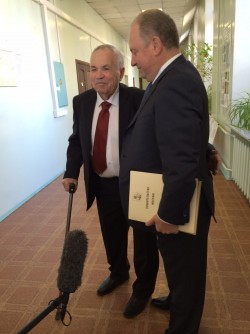
Answering journalists’ questions, Nikolai Sergeevich said:
– I am retired, but I continue to work: I consult doctors who encounter some difficulties in diagnosing a disease or prescribing treatment. Dermatology is a rather complex specialty, and I focus on those points that a person studying skin diseases needs to know: the meaning of terms, unusual manifestations of disease, peculiar symptoms, etc. At present, I carry out scientific, treatment, and consulting work at the Moscow Scientific and Practical Center for Dermatovenereology and Cosmetology of the Moscow Department of Health.
– You continue to see patients—probably these are difficult cases, or are you still interested in some particular aspect of the patient’s illness?
– A doctor encounters a patient whose diagnosis he cannot figure out—unfortunately, there are many such cases, and they are discussed during consultations. I continue to provide consultations and, of course, to see patients. Since the time of Hippocrates there has been a saying: if a patient does not feel better after speaking with a doctor, then that is a bad doctor! You have probably heard of Academician Vorobyev? He and I, together with Chazov, worked for many years; and he used to say that every doctor, during the course of a year, must обязательно spend time in the skin of a sick person and lie in a hospital bed—only then will the doctor understand how one should treat a patient!
– What advice can you give your many students today?
– I have been speaking about this practically since the moment I myself became a student of Professor Viktor Aleksandrovich Rakhmanov. Medicine at any time — and in our time as well — has many shortcomings that depend on various causes, but there is one that depends entirely on the doctor: attentive treatment of the sick person. Unfortunately, at present I often observe a violation of this principle! When I was an assistant resident at the Clinic of Skin and Venereal Diseases of the First Moscow Medical Institute, and Rakhmanov headed the department, I remembered, and still remember, his reaction to the situation when a young doctor addressed an elderly patient using “ты”. He would simply fly into a rage! He told us: if we do not know how to cure, then at least we must know how to be polite to the patient!
– Today the world has undergone enormous changes not only in terms of human relations and technological progress, but unfortunately also in terms of new diseases, including skin diseases. Have they always existed with humankind, or are they still new acquisitions?
– Yes, new diseases are appearing, and apparently more will appear! I was the first in Russia to identify patients with HIV infection, which at that time was called immunodeficiency. This disease was first recorded in America in 1981; in 1984, together with doctors, I was able at the Central Clinical Hospital to isolate this infection for the first time in a native of Africa, and in 1987 — in one of our compatriots. In 1988, I held the All-Union Conference on HIV Infection, which was the first conference of such scale on such a serious disease.
– How do you assess the current state of dermatovenereology?
– Things are not so bad with us! True, it is still too early to talk about a plan for eradication, but I must say that the last syphilis epidemic on the territory of Russia was at the end of the twentieth century, in the 1990s. We would have coped much faster if patients had been treated in hospital, but as a rule they were prescribed outpatient treatment. Unfortunately, not all patients were treated by specialist doctors — many were treated by nurses or somewhere on the advice of friends, and therefore we should now expect the appearance of patients with late-stage syphilis.
– What would you like to wish your patients?
– To see doctors as rarely as possible and to take care of their health.
…“I get tired when I have nothing to do!” — Nikolai Sergeevich Potekaev once said in an interview. It is probably this simple truth that determined not only his further destiny as a scientist and person, but also still allows him to remain in service, to help people, to be needed by his many students, and to continue improving himself and his scientific school.
Elena Mokhova